Is Crawl Space Encapsulation Worth It in Arkansas?
What encapsulation actually includes, what it costs, what it returns in energy and structural terms, and the situations where we tell homeowners not to bother.
The vented crawl space was always a bad idea here
Building codes required crawl space vents for decades on the theory that airflow dries things out. In a humid climate it does the opposite. Warm moist summer air enters the vents, contacts framing and ductwork that are cooler than the dew point, and condenses. You are effectively watering the underside of your house every afternoon from June through September.
That is why so many Northwest Arkansas homes have rotting rim joists, cupped hardwood on the floor above, insulation lying on the ground where it fell years ago, and a musty smell nobody can locate. The crawl space is the source of a large share of the air you breathe upstairs.
What encapsulation actually includes
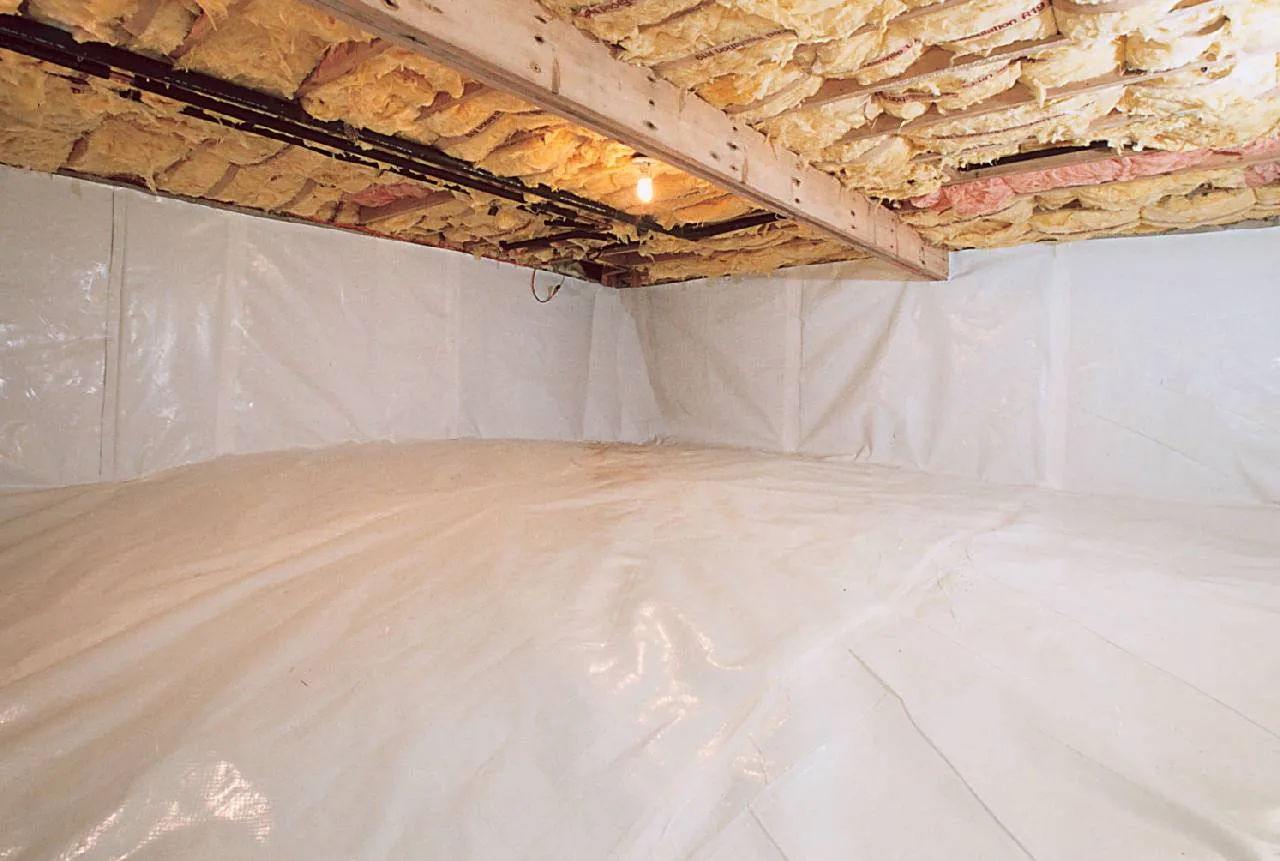
A real encapsulation is not a sheet of plastic thrown on the dirt. It is: debris and old insulation removed; any standing-water source addressed with drainage and a sump if needed; a heavy vapor barrier — typically 12-mil or better — laid over the ground and run up the foundation walls; seams overlapped and taped; the barrier mechanically fastened and sealed at the wall termination; vents sealed; rim joists air-sealed and insulated; and a dedicated dehumidifier sized to the cubic footage with a condensate line to daylight or the sump.
If a quote is missing the drainage assessment or the dehumidifier, it is a vapor barrier job, not an encapsulation, and it will underperform.
What it costs and what comes back
Encapsulation in this region typically runs $4,800 to $11,000 depending on square footage, headroom, how much debris has to come out, and whether drainage work is needed first.
The returns are real but they are not all financial. Homeowners commonly see a measurable drop in heating and cooling costs in the first year, because the HVAC is no longer fighting a humid buffer zone and the ductwork running through it is no longer sweating. Hardwood floors stop moving seasonally. The smell goes away. Indoor air quality improves, which matters more than people expect given how much crawl space air ends up upstairs through the stack effect.
The largest return is the one you never see: framing that does not rot. Sistering joists and replacing a rim joist after fifteen years of condensation costs considerably more than the encapsulation would have.
When we tell people not to do it
If the crawl space is genuinely dry — low moisture readings in the framing across multiple visits, no staining, no smell, good grade and gutters outside — encapsulation is a want rather than a need. Some crawl spaces on well-drained upland lots really are fine.
If there is active water intrusion, encapsulating first is the wrong order of operations. Fix the water, then seal. A vapor barrier over a crawl space that floods is a swimming pool liner.
And if the home is about to be sold and the buyer will likely gut or re-plumb, it may make more sense to disclose and price accordingly than to spend the money yourself.
Encapsulation and foundation movement
There is a structural angle people miss. A crawl space that stays saturated keeps the soil under the interior piers at a different moisture content than the soil under the exterior footing. Different moisture, different volume, differential movement — the same mechanism that causes settlement from bad drainage outside, happening under the middle of your house.
We have measured interior floor sag on homes where the perimeter was completely stable, and the cause was a wet crawl space, not a failed footing. Drying it out was most of the fix.
Getting a straight answer about your crawl space
Ask for moisture meter readings on the joists and the rim, not just an opinion. Ask what the plan is for water, not only for vapor. Ask what size dehumidifier and why that size.
We inspect crawl spaces free across Fayetteville, Springdale, Rogers, Bentonville and Bella Vista, and we will tell you plainly if yours does not need the work. (479) 225-4899.
Want this looked at by someone who does it every day?
Free inspections across Fayetteville, Springdale, Rogers, Bentonville and Bella Vista — elevation measurements, photographs and a fixed written price, with no obligation.