7 Drainage Mistakes That Crack Arkansas Foundations
Most foundation repairs in Northwest Arkansas start as a water problem somebody could have fixed for a few hundred dollars. Here are the seven we find most often.
Water moves foundations. Almost nothing else does.
Northwest Arkansas gets roughly 48 inches of rain a year, and expansive clay that swells when it is wet and shrinks when it is dry. Foundations here do not fail because concrete is weak. They fail because the moisture content of the soil under one part of the house is different from the moisture content under another part, so one side moves and the other does not.
That means most foundation repair is really deferred drainage repair — and drainage repair is dramatically cheaper. Here are the seven mistakes we find over and over.
1. Downspouts discharging at the wall
This is the most common and most damaging mistake we see. A downspout with a six-inch elbow at the bottom is not draining your roof away from the house — it is concentrating a thousand square feet of roof runoff into one spot eighteen inches from your footing.
In a one-inch rain that is roughly 600 gallons delivered to a single point. Extend discharge four to six feet minimum, farther on a slope, and bury solid line to daylight where surface extensions are impractical.
2. Grade that falls toward the house
You want about six inches of fall in the first ten feet away from the wall. Over the years, settling backfill, added mulch, new flower beds and landscape edging routinely reverse that slope without anyone noticing.
Walk your foundation after a hard rain and look for standing water or a visible puddle line. If water sits against the wall for hours, the clay right there is at maximum swell while the clay under the middle of the house is not. That differential is what cracks things.
3. Flower beds and mulch built up against the siding
Beds directly against the foundation cause two problems at once: they are usually irrigated, which keeps the soil in one strip permanently wet, and mulch piled high traps that moisture against the wall. On a brick home it can also bridge above the weep holes and let water into the wall cavity.
Keep bed soil several inches below the siding line, slope beds away from the house, and put drip irrigation on a separate zone from the lawn so you are not soaking the perimeter every other evening in July.
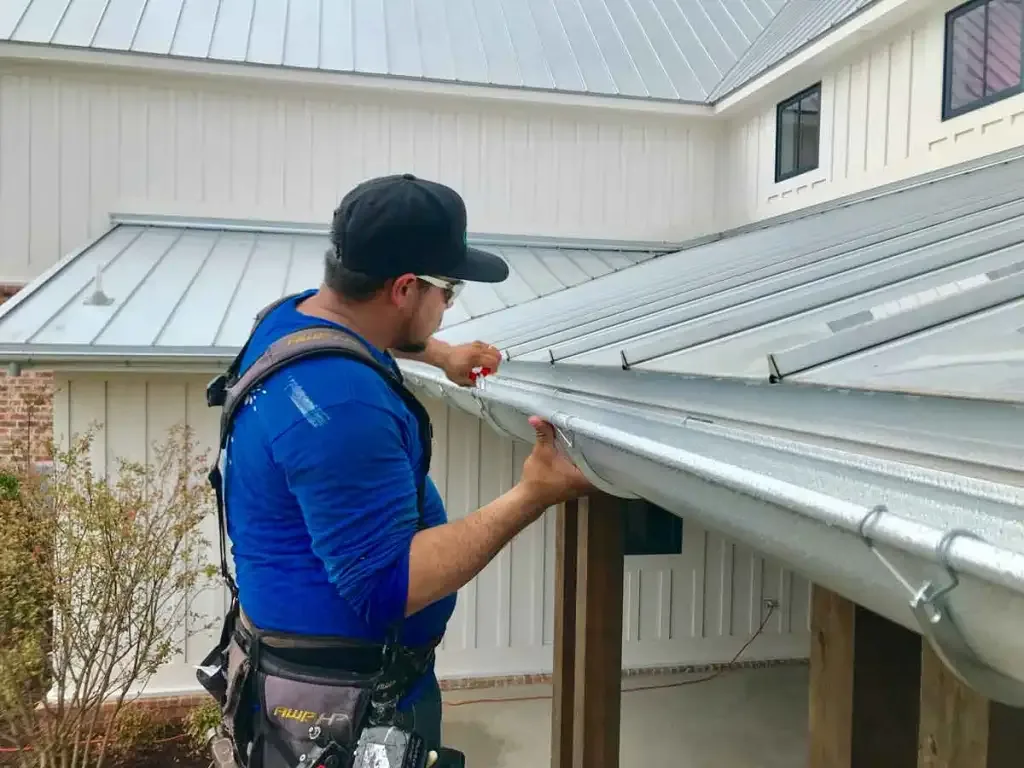
4. Gutters that are undersized, clogged or back-pitched
A 5-inch gutter on a long steep run will overflow in a serious storm no matter how clean it is, and overflow lands in a concentrated line right at the foundation. Sagging or back-pitched runs do the same thing in a much smaller storm.
Watch your gutters during the next real downpour. Water sheeting over the front lip means the system is too small, too clogged, or hung wrong — and it is functionally the same as having no gutters at all.
5. Trees planted too close
A mature oak can pull hundreds of gallons of water a day out of the soil in summer. Planted within about fifteen feet of the foundation, that dries the clay on one side of the house far faster than the other, which is why so many drought-year settlement calls are on the side of the house with the big tree.
Removing a mature tree is a serious decision and often not the right one — root barriers and supplemental deep watering during drought can manage the differential instead. But if you are planting new, keep large species well clear of the structure.
6. A slab plumbing leak nobody noticed
A supply line weeping under a slab washes fines out of the soil and creates a void, and the slab eventually drops into it. The symptoms look exactly like ordinary settlement, which is why we always ask about unexplained water bill increases, a warm spot on the floor, or the sound of running water when everything is off.
This matters financially too: sudden plumbing-leak damage is frequently covered by homeowners insurance, while gradual settlement generally is not. Identifying the cause correctly can be worth thousands.
7. Hardscape that dams water against the house
Patios, driveways and sidewalks that have settled toward the house now pitch water back at the foundation every time it rains, and a raised concrete edge or landscape wall can trap it there. This one is sneaky because the hardscape looks solid and permanent, so nobody suspects it.
Lifting the slab back to correct pitch with foam usually costs a fraction of what the resulting foundation repair would, and it fixes the drainage and the trip hazard in the same visit.
The cheapest foundation work you will ever buy
Correcting grade, extending downspouts and re-hanging gutters is usually a four-figure job at most, and on a meaningful number of houses it stops the movement outright. We would genuinely rather sell you that than a pier system you did not need.
If you are seeing early symptoms and want to know whether it is a water problem or a structural one, get a free inspection: (479) 225-4899.
Want this looked at by someone who does it every day?
Free inspections across Fayetteville, Springdale, Rogers, Bentonville and Bella Vista — elevation measurements, photographs and a fixed written price, with no obligation.