Retaining Wall Failure: The Warning Signs and What a Rebuild Costs
Leaning, bulging, cracking or separating at the joints — how to read a failing retaining wall, why the wall is almost never the real problem, and what it costs to do it properly.
The wall is rarely the thing that failed
When a segmental block retaining wall starts leaning out, the instinct is to blame the blocks. Almost always, the blocks are fine. What failed is the soil behind them, or more precisely the water in that soil.
A retaining wall holds back a wedge of earth that wants to slide. Dry soil is relatively light and pushes with a predictable force the wall was engineered for. Saturate that same soil and two things happen at once: it gets substantially heavier, and water pressure builds behind the wall with nowhere to go. That combined load can be several times the design pressure. The wall then does exactly what physics says it will.
This is why we start every retaining wall assessment uphill of the wall, not at it.
Sign 1: leaning outward at the top
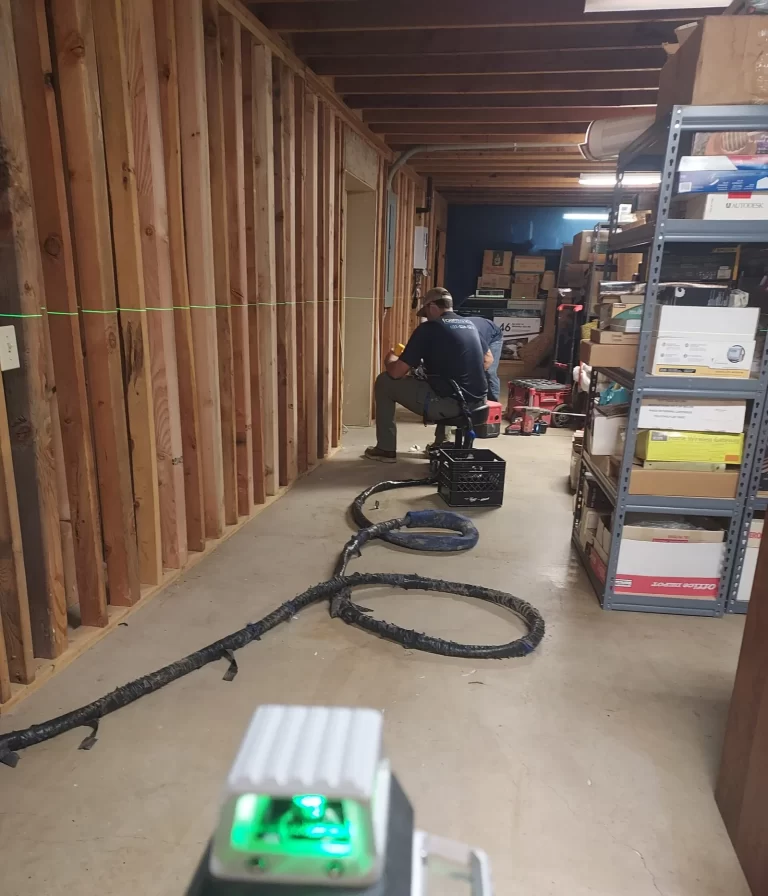
Stand at one end and sight along the face. A wall that has rotated forward at the top while the base has stayed put is under active soil pressure and is losing. Measure it: hold a level against the face and note the gap at the top, or drop a plumb line from the top course and measure to the base.
Write the number and the date down. A wall that has been leaning two inches for fifteen years is a very different problem from one that has moved two inches since spring. The first can be monitored. The second is failing now.
Sign 2: bulging in the middle of the run
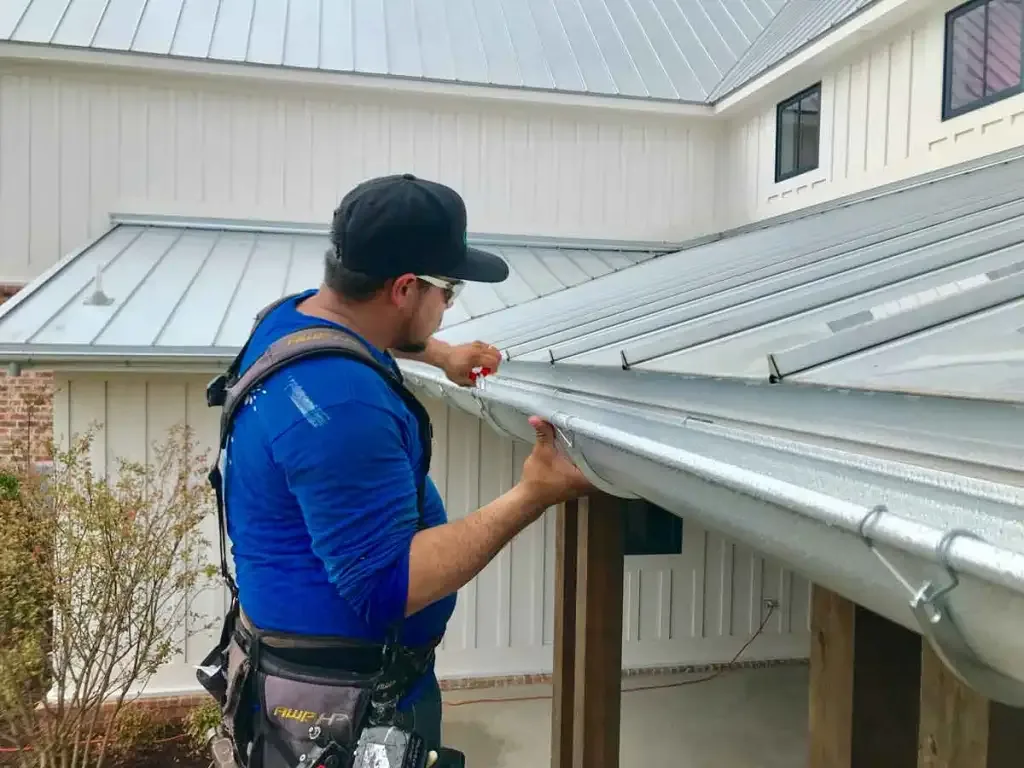
A belly in the middle of an otherwise straight wall means pressure is concentrated there — usually because water is collecting at that point. Look uphill for the reason: a downspout discharging above the wall, a low spot that ponds, a neighbouring grade draining toward you, or a leaking irrigation line.
Bulging is more urgent than uniform lean. A uniform lean distributes load across the whole structure; a bulge means one section is carrying far more than its share and will fail first.
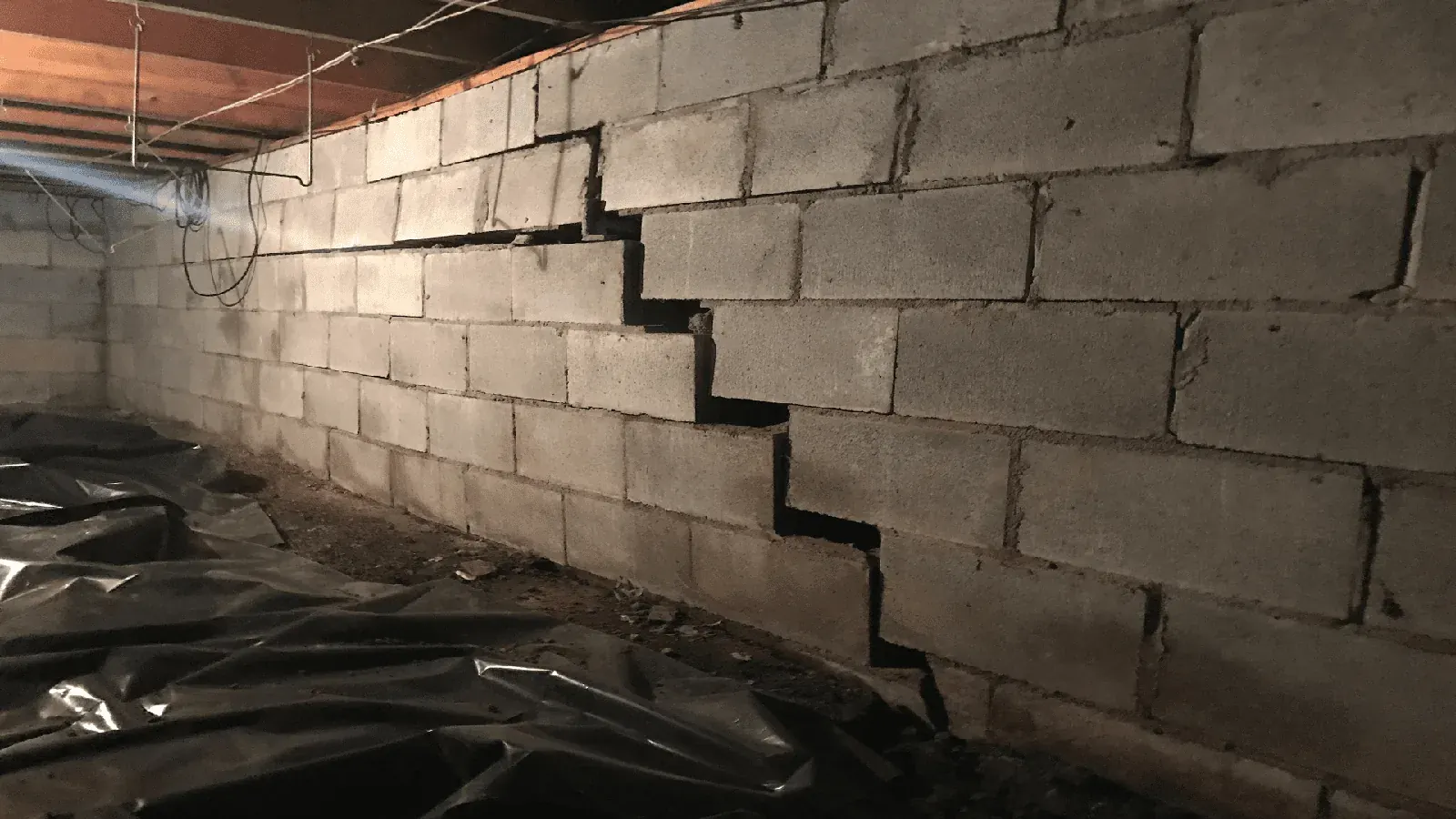
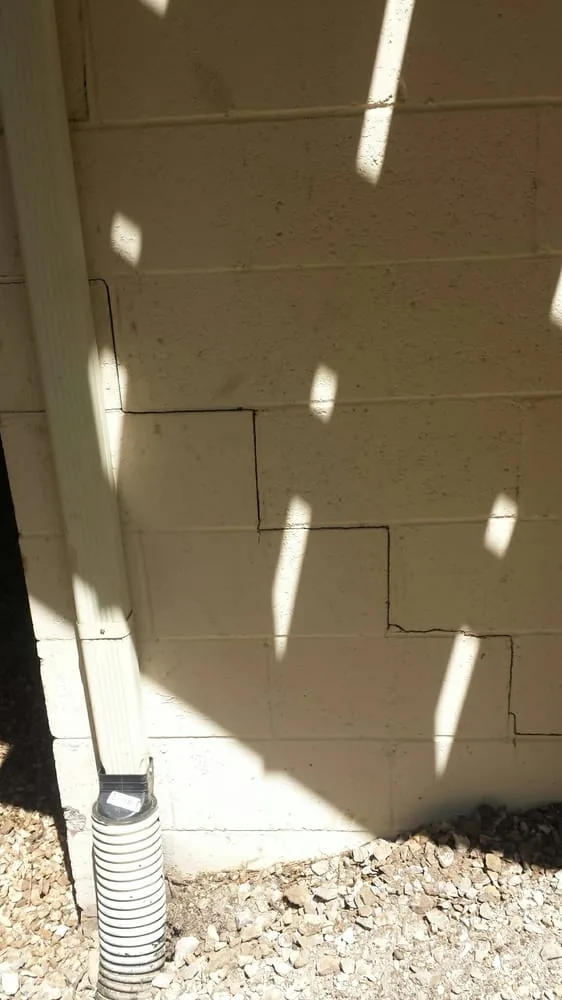
Sign 3: stair-step separation at the joints
On block walls, look at the vertical joints between units. If they have opened into visible gaps that widen toward the top, the wall is being pulled apart laterally as it rotates. On poured concrete walls the equivalent sign is vertical cracking with the two faces offset out of plane.
Either pattern means the wall has lost its ability to act as one continuous structure. Patching the joints does nothing, because the movement will simply reopen them.
Sign 4: soil or water escaping through the face
Fines washing out through the joints tell you the drainage aggregate behind the wall has either been omitted or has clogged, and that groundwater is now moving through the wall rather than around it. Every cup of soil that washes out is a void forming behind the wall.
This one is easy to dismiss because it looks cosmetic. It is not. It is the wall telling you its drainage system has stopped working.
Sign 5: cracking or sinking in the ground above the wall
A crack running parallel to the wall a few feet back from the top edge is a tension crack. It means the whole soil wedge has begun moving as a block. This is the most serious sign on the list, and on a steep lot above a house or driveway it is a safety issue rather than a maintenance item.
If you see this, keep people and vehicles off the area below the wall until it has been assessed.
Why Bella Vista and hillside Fayetteville see this constantly
Most Bella Vista lots were cut into a hillside, which means the terrace your house sits on is being held in place by something. Often that something is a wall built to a residential standard on a slope that really behaves like a small engineering problem.
Add thin rocky soil over weathered limestone, karst seams that route water in ways nobody predicted, and short intense storms, and you get walls that were adequate in a normal year and overwhelmed in a wet spring. Northwest Arkansas hillside walls fail on drainage, not on masonry.
What a proper rebuild includes
Rebuilding a failed wall without fixing the reason it failed just resets the clock. A correct rebuild has four parts: a level compacted base below frost depth, clean drainage stone behind the full height of the wall, a perforated drain line at the base of that stone daylighted somewhere sensible, and geogrid reinforcement tied back into the retained soil at intervals for anything above roughly four feet.
Geogrid is the part most commonly skipped, because it is buried and nobody can see whether it is there. It is also the part that turns a stack of blocks into a reinforced soil mass. Ask specifically whether your quote includes it, and at what vertical spacing.
Above about four feet, most Northwest Arkansas jurisdictions require an engineered design and a permit. That is worth having regardless of the code minimum.
What it costs
Cost varies widely with height, length, access and whether the existing wall has to be removed, so treat these as orientation rather than a quote. Small repairs to a short wall that already has good drainage can run a few thousand dollars. A full rebuild with proper drainage stone, drain line and geogrid is normally priced by the square foot of wall face, and rises sharply once equipment access becomes difficult.
The genuinely expensive scenario is the one where wall failure has already started undermining a driveway, a patio or a foundation above it. That is the argument for looking at it early: the wall is almost always the cheapest thing in the sequence.
Get it measured before the next wet spring
We assess retaining walls free across Northwest Arkansas, including the POA approval work that Bella Vista lots require. You get the measured lean, the drainage diagnosis, and a written scope separating what is urgent from what can wait.
Call (479) 225-4899 or request an inspection online.
Want this looked at by someone who does it every day?
Free inspections across Fayetteville, Springdale, Rogers, Bentonville and Bella Vista — elevation measurements, photographs and a fixed written price, with no obligation.